
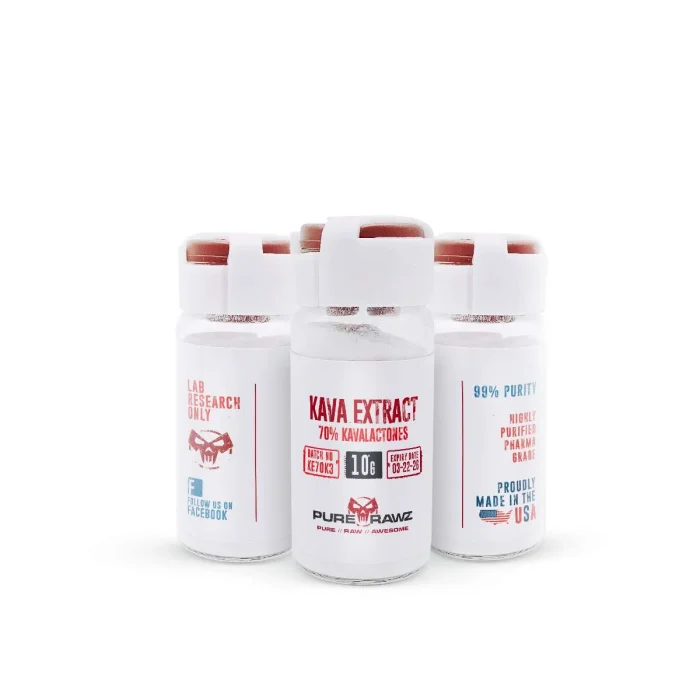
Overview of Kava Extract 70% Kavalactones
Kava extract is derived from the root of Piper methysticum, a plant traditionally cultivated in the South Pacific region. The extract contains a group of bioactive compounds known as kavalactones, which are lipophilic lactone molecules that have been widely examined in experimental phytochemistry and molecular pharmacology research. Major kavalactones commonly identified in kava root include kavain, dihydrokavain, methysticin, dihydromethysticin, yangonin, and desmethoxyyangonin.
In laboratory investigations, these compounds have been studied for their interactions with receptor-mediated signaling pathways, enzyme systems, and ion channel modulation mechanisms. Experimental models indicate that kavalactones can interact with various receptor targets and metabolic enzymes that regulate neurotransmission and cellular signaling processes. Research involving kavalactones frequently utilizes in vitro assays and preclinical experimental models to evaluate their molecular interactions and biochemical characteristics.
Kava extract standardized to 70% kavalactones provides a concentrated composition of these compounds suitable for analytical chemistry, biochemical assays, and experimental laboratory research.
Chemical and Molecular Properties
Because kava extract is a multi-compound botanical extract, its chemical composition consists of several related kavalactones rather than a single defined molecule. Only verified and widely reported properties of the extract and its principal constituents are included below.
| Kava Kava | |
| PubChem CID | 5899068 for Kava Kava |
| Molecular Formula | Not valid because the extract contains multiple molecules |
| Molecular Weight | Not applicable |
| Source | Piper methysticum (kava root) |
| Major Constituents | Kavain, Dihydrokavain, Methysticin, Dihydromethysticin, Yangonin, Desmethoxyyangonin |
| CAS | Not applicable |
| Labeling | Research Use Only (RUO), not for human or animal consumption. |
| Purity | 70% Total Kavalactones |
| Classification | Research Use Only (RUO) |
| Storage Temperature | Lyophilized: –20 °C or colder |
| Solubility | Soluble in organic solvents such as ethanol and DMSO in laboratory settings |
| Safety | Handle with gloves, a lab coat, eye protection; use a fume hood if dust/aerosol is possible |
Various Mechanisms of Kava Extract 70% Kavalactones
Modulation of GABA-Associated Receptor Signaling
Experimental electrophysiological studies have examined the interaction of kavalactones with γ-aminobutyric acid type A (GABA A) receptors. In receptor expression systems, kavain has demonstrated positive modulatory effects across multiple receptor subtypes, indicating a potential interaction with receptor-associated ion channel activity. Importantly, the observed modulation occurs through a mechanism distinct from classical benzodiazepine binding sites, suggesting a unique receptor interaction profile.
These receptor-binding characteristics are commonly investigated in cellular expression systems and electrophysiological assays, allowing researchers to evaluate how plant-derived lactones influence receptor-mediated ion flux in controlled experimental conditions.
Enzyme Interaction and Metabolic Pathway Modulation
Certain kavalactones have been evaluated for their ability to interact with metabolic enzyme systems. Laboratory investigations have demonstrated that multiple kavalactones can influence the activity of carboxylesterase 1 (CES1), an enzyme involved in the hydrolysis of various ester-containing compounds. In vitro kinetic studies have reported reversible inhibition patterns with distinct inhibition constants depending on the specific kavalactone involved.
Such findings have contributed to research exploring how plant-derived lactones may interact with enzyme-mediated metabolic pathways within biochemical assay systems.
Monoamine Oxidase Enzyme Interactions
Several kavalactones have also been examined in monoamine oxidase (MAO) enzyme assays, which evaluate interactions with enzymes responsible for neurotransmitter metabolism. Experimental enzyme inhibition studies have reported that compounds such as kavain and yangonin interact with both MAO-A and MAO-B isoforms under controlled laboratory conditions.
These interactions are typically evaluated in enzyme kinetic models that examine competitive or reversible binding between small molecules and enzyme active sites.
Ion Channel Modulation
Additional experimental work has investigated the interaction of kavalactones with ligand-gated ion channels, including glycine receptors expressed in recombinant cell models. In vitro experiments using HEK293 expression systems demonstrated that several kavalactones, including kavain and dihydrokavain, can alter glycine receptor activity in a concentration-dependent manner.
Such studies contribute to the broader understanding of how plant-derived lactone structures interact with membrane-associated receptor proteins and ion channels in experimental models.
Research Applications of Kava Extract in Laboratory Settings
Kava extract (70% kavalactones) is widely used in experimental and preclinical research to investigate the molecular interactions of kavalactones with receptors, ion channels, and enzymatic pathways. Researchers employ this extract in in vitro assays, receptor-binding studies, electrophysiological models, and biochemical enzyme assays to explore cellular signaling, metabolic processes, and membrane-associated mechanisms. Its well-characterized composition of kavain, dihydrokavain, methysticin, dihydromethysticin, yangonin, and desmethoxyyangonin makes it a valuable tool for studying natural product pharmacology and cellular signaling in controlled laboratory settings.
Why Choose Purerawz for Kava Extract 70% Kavalactone?
Buy Kava Extract 70% Kavalactone for laboratory research use from our online shop. At Purerawz, we provide high-quality reference materials. Each research compound comes with a Certificate of Analysis for verification of purity and concentration.
Note:
Kava Extract 70% Kavalactone is an investigational compound currently undergoing clinical evaluation and has not been established as safe or effective for any therapeutic use
Disclaimer
This information is for educational purposes only and not medical advice. Products are for research use only. Research must follow IRB or IACUC guidelines. Verify information independently before purchasing. By ordering, you agree to our Terms and Conditions. If you are not 100% satisfied with the product you received, please contact us at support@purerawz.co
ATTENTION: All our products are for LABORATORY AND RESEARCH PURPOSES ONLY, not for veterinary or human use
Reference Links
Kormann, E. C., Amaral, P. A., David, M., Eifler-Lima, V. L., Cechinel-Filho, V., & Buzzi, F. C. (2012). Kavain analogues as potential analgesic agents. Pharmacological Reports, 64(6), 1419–1426. https://pubmed.ncbi.nlm.nih.gov/23406752/
Hegazy, N. H., Breitinger, H.-G., & Breitinger, U. (2019). Kavalactones from Piper methysticum root extract as modulators of recombinant human glycine receptors. Biological Chemistry, 400(9), 1205–1215. https://pubmed.ncbi.nlm.nih.gov/31141476/
Melchert, P. W., Qian, Y., Zhang, Q., Klee, B. O., Xing, C., & Markowitz, J. S. (2022). In vitro inhibition of carboxylesterase 1 by Kava (Piper methysticum) kavalactones. Chemico-Biological Interactions, 357, 109883. https://pubmed.ncbi.nlm.nih.gov/35278473/
Prinsloo, D., van Dyk, S., Petzer, A., & Petzer, J. P. (2019). Monoamine oxidase inhibition by kavalactones from kava (Piper methysticum). Planta Medica, 85(14-15), 1136–1142. https://pubmed.ncbi.nlm.nih.gov/31539917/
Schmidt, M., Kruse, A. C., & Lummis, S. C. R. (2016). Kavain, the major constituent of the anxiolytic kava extract, potentiates GABA_A receptors: Functional characteristics and molecular mechanism. Journal of Pharmacology and Experimental Therapeutics. https://pubmed.ncbi.nlm.nih.gov/27332705/
Related Research Compounds for Kava Extract 70% Kavalactones
If you’re looking to buy Kava Extract 70% Kavalactones, you may also be interested in other nootropic compounds, relaxation research products, and neurochemical pathway compounds used in laboratory studies involving mood support, stress response, cognitive balance, and neurotransmitter regulation.
Inbound Internal Links
- Buy Semax – Popular nootropic peptide for cognitive and neurochemical research.
- Buy MK-677 – Recovery and sleep-support research compound.
- Buy Sermorelin – Growth hormone pathway research with recovery applications.
- Buy CJC-1295 – GH-related peptide for recovery and wellness studies.
- Ipamorelin for Sale – Research compound used for recovery and restorative pathway studies.
Outbound Internal Links
- BPC-157 for Sale – Recovery peptide for tissue repair and wellness studies.
- TB-500 for Sale – Regeneration peptide for advanced healing research.
- Buy Semaglutide – Metabolic peptide for appetite and regulation studies.
- Tirzepatide for Sale – Advanced metabolic research peptide.
- Retatrutide for Sale – Triple agonist peptide for metabolic pathway studies.
External Authority Links
- PubChem – Scientific compound reference database.
- NCBI – Peer-reviewed biomedical research studies.
- ClinicalTrials.gov – Registered clinical and research studies.
Reviews
There are no reviews yet.